Bodie, California
| Bodie | |
|---|---|
| — Ghost town — | |
 | |
| | |
| Coordinates: 38°12′44″N 119°00′44″W / 38.21222°N 119.01222°WCoordinates: 38°12′44″N 119°00′44″W / 38.21222°N 119.01222°W | |
| Country | United States |
| State | California |
| County | Mono |
| Founded | 1876 |
| Government | |
| • None | |
| Elevation | 8,379 ft (2,554 m) |
| Population (1962) | |
| • Total | 3 |
| Time zone | PST (UTC-8) |
| • Summer (DST) | PDT (UTC-7) |
| ZIP code | 93517 |
| Area code(s) | 760 |
| Website | Bodie State Historic Park |
| Bodie Historic District | |
 | |
| Bodie, California, as seen from the hill, looking toward the cemetery | |
| Location: | California |
| Nearest city: | Bridgeport, California |
| Architectural style: | Various; Southwestern U.S. frontier-style, late-19th to early-20th century. |
| Governing body: | State |
| NRHP Reference#: | 66000213 |
| CHL #: | 341 |
| Significant dates | |
| Added to NRHP: | October 15, 1966 |
| Designated NHLD: | July 4, 1961 |
Bodie is a ghost town in the Bodie Hills east of the Sierra Nevada mountain range in Mono County, California, United States, about 75 miles (120 km) southeast of Lake Tahoe. It is located 12 miles (19 km) east-southeast of Bridgeport, at an elevation of 8379 feet (2554 m). As Bodie Historic District, the U.S. Department of the Interior recognizes it as a National Historic Landmark. The ghost town has been administered by California State Parks since becoming a state historic park in 1962, and receives about 200,000 visitors yearly.
History
Discovery of gold
Bodie began as a mining camp of little note following the discovery of gold in 1859 by a group of prospectors, including W.S. Bodey (first name uncertain). Bodey perished in a blizzard the following November while making a supply trip to Monoville (near present day Mono City, California), never getting to see the rise of the town that was named after him. According to area pioneer, Judge J.G. McClinton, the district's name was changed from "Bodey," "Body," and a few other phonetic variations, to "Bodie," after a painter in the nearby boomtown of Aurora lettered a sign "Bodie Stables" Gold discovered at Bodie coincided with the discovery of silver at nearby Aurora, Nevada, and the distant Comstock Lode beneath Virginia City, Nevada. But while these two towns boomed, interest in Bodie remained lackluster. By 1868 only two companies had built stamp mills at Bodie, and both had failed.
Boom
Geography of the boomtown
Mining town
Decline
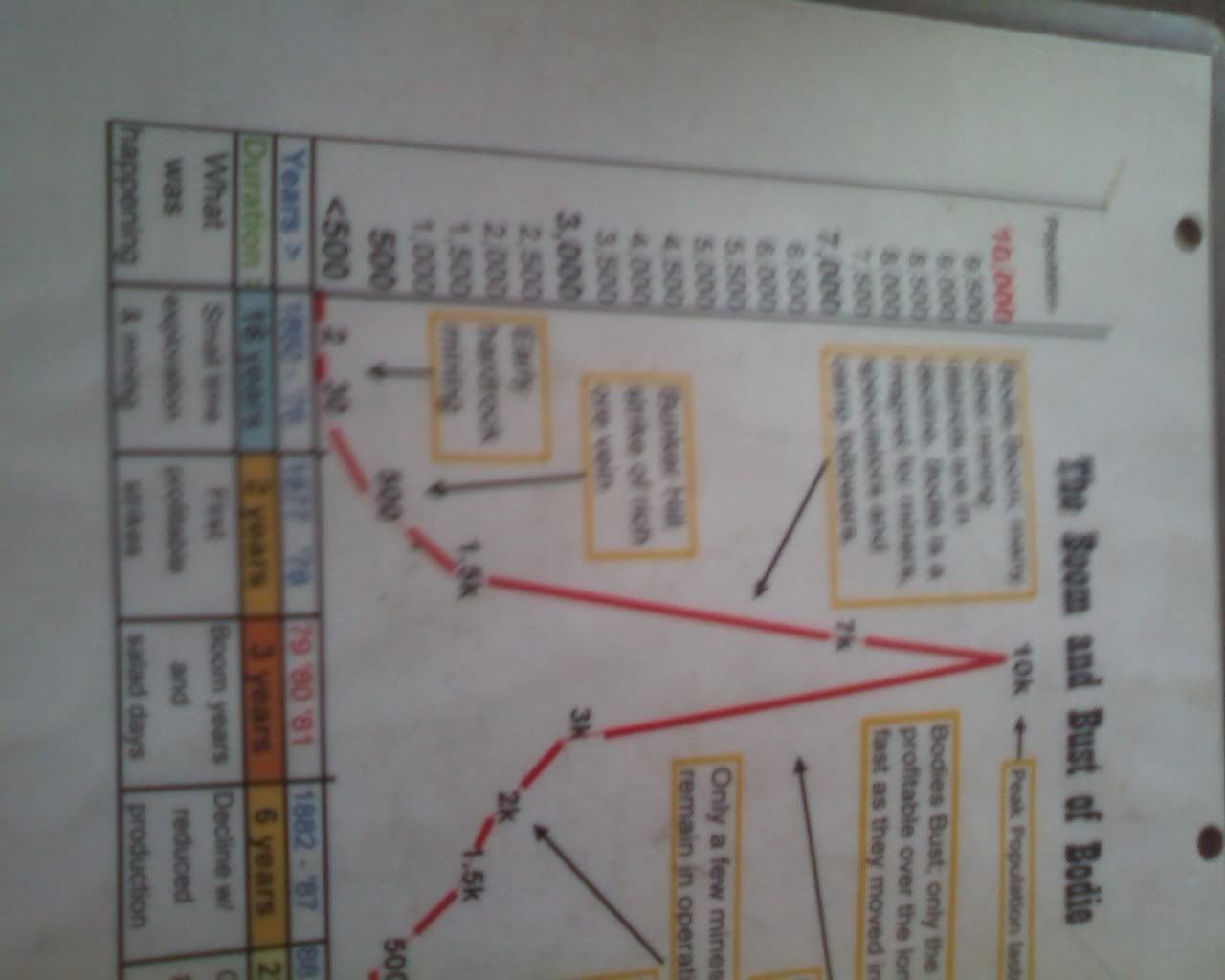
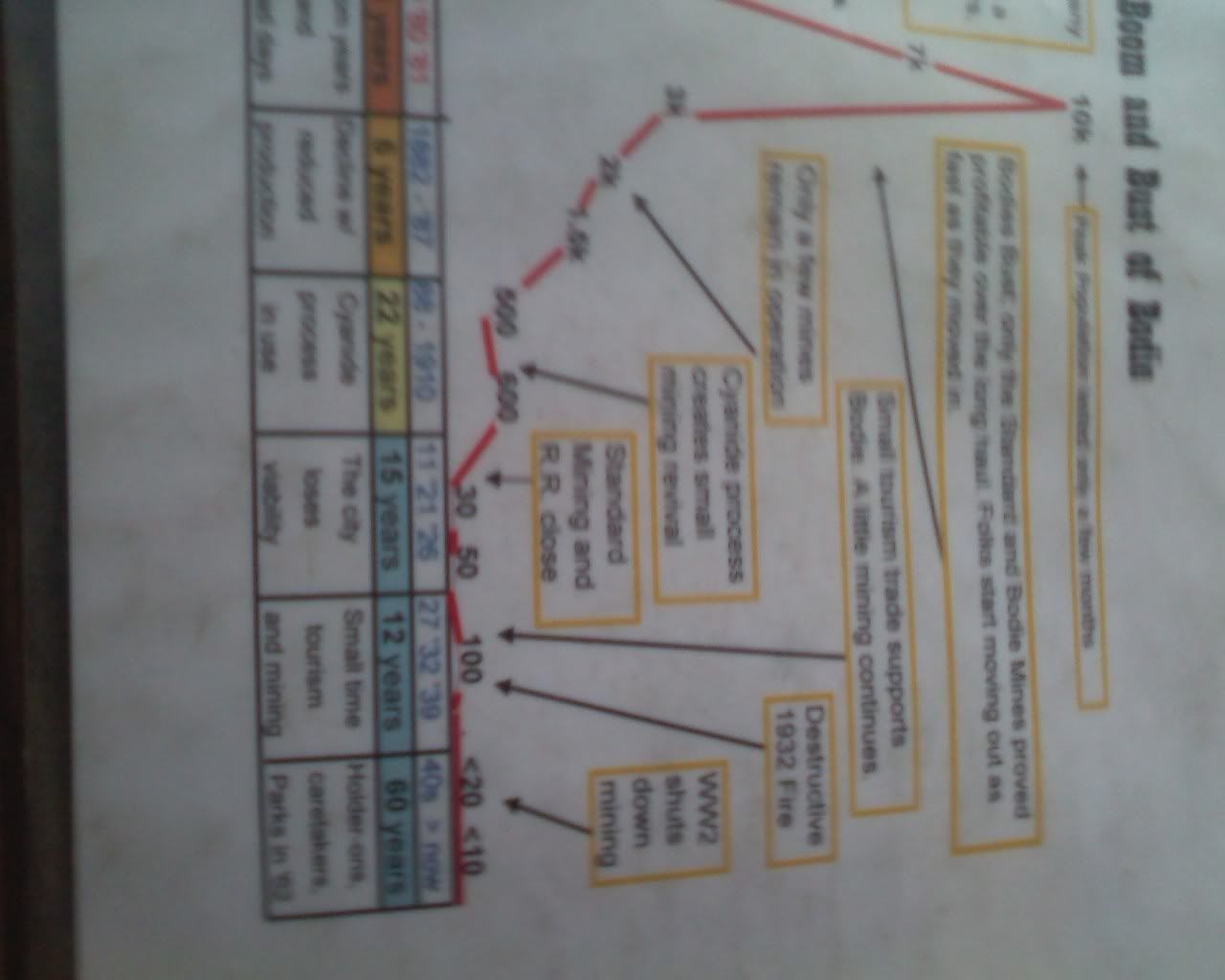
| Historical populations | |||
|---|---|---|---|
| Census | Pop. | %± | |
| 1880 | 2,712 | | |
| 1890 | 1,595 | −41.2% | |
| 1900 | 965 | −39.5% | |
| 1910 | 698 | −27.7% | |
| 1920 | 110 | −84.2% | |
| 1930 | 228 | 107.3% | |
| 1940 | 90 | −60.5% | |
| Source: | |||
The first signs of an official decline occurred in 1912 with the printing of the last Bodie newspaper, The Bodie Miner. In a 1913 book titled California tourist guide and handbook: authentic description of routes of travel and points of interest in California, the authors, Wells and Aubrey Drury described Bodie as a "mining town, which is the center of a large mineral region" and provided reference to two hotels and a railroad operating there. In 1913, the Standard Consolidated Mine closed. Mining profits in 1914 were at a low of $6,821. James S. Cain was buying up everything from the town lots to the mining claims, and reopened the Standard mill to former employees, which resulted in an over $100,000 profit in 1915. However, this financial growth was not in time to stop the town's decline. In 1917, the Bodie Railway was abandoned and its iron tracks were scrapped. The last mine closed in 1942, due to War Production Board order L-208, shutting down all nonessential gold mines in the United States. Mining never resumed.
The first label of Bodie as a "ghost town" was in 1915. In a time when auto travel was on a rise, many were adventuring into Bodie via automobiles. The San Francisco Chronicle published an article in 1919 to dispute the "ghost town" label. By 1920, Bodie's population was recorded by the US Federal Census at a total of 120 people. Despite the decline, Bodie had permanent residents through most of the 20th century, even after a fire ravaged much of the downtown business district in 1932. A post office operated at Bodie from 1877 to 1942.
Ghost town and park
Climate
See also
Notes
References
- Calloway, R.A. (1979). Bodie State Historic Park: resource management plan, general development plan and environmental impact report. Sacramento: Calif. Dept. of Parks and Recreation. OCLC 21629664.
- Jackson, W.T. (1962). Historical material on the mining town of Bodie, California: a critical bibliography. Sacramento: California Division of Beaches and Parks. OCLC 58742626.
- Johnson, R.; Johnson, A (1967). The ghost town of Bodie, as reported in the newspapers of the day. Bishop, Calif: Printed and distributed by Chalfant Press for Sierra Media. OCLC 1592631.
- McDonald, D. (1988). Bodie, boom town-gold town: the last of California's old-time mining camps. Las Vegas, Nev: Nevada Publications. ISBN 0913814881. OCLC 21384472.
- Morse, T.I.; Joseph, L. (1990). Photographing Bodie: a photographer's guide to the ghost town of Bodie, California. Santa Barbara, Calif: Global Preservation Projects. OCLC 54961458.
- Piatt, Michael H. (2003). Bodie: "The Mines Are Looking Well...". El Sobrante, Calif: North Bay Books. ISBN 0972520058.
- Retailers Protective Association (1880). Delinquent list of Virginia City, Gold Hill, Carson and Reno Nevada, and Bodie, California. OCLC 28163028.
- Wedertz, F.S. (1969). Bodie, 1859–1900. Bishop, Calif: Chalfant Press. OCLC 27440.
External links
- Official Bodie State Historic Park website
- Bodie area maps and information
- Bodie Foundation – A non-profit organization
- National Park Service: A History of Chinese Americans in California: Bodie Chinese American Community
- The latest research on Bodie
- Learn about and tour Bodie online at Bodie.com
- Story of Bodie – Stereoscopic Video Project
- Bodie in 1865 and recent photographs
- Historical Population Line Graph Image #1
- Historical Population Line Graph Image #2
- Bodie Fan Community
- Alabama
- Alaska
- Arizona
- Arkansas
- California
- Colorado
- Connecticut
- Delaware
- Florida
- Georgia
- Hawaii
- Idaho
- Illinois
- Indiana
- Iowa
- Kansas
- Kentucky
- Louisiana
- Maine
- Maryland
- Massachusetts
- Michigan
- Minnesota
- Mississippi
- Missouri
- Montana
- Nebraska
- Nevada
- New Hampshire
- New Jersey
- New Mexico
- New York
- North Carolina
- North Dakota
- Ohio
- Oklahoma
- Oregon
- Pennsylvania
- Rhode Island
- South Carolina
- South Dakota
- Tennessee
- Texas
- Utah
- Vermont
- Virginia
- Washington
- West Virginia
- Wisconsin
- Wyoming


Retrieved from : http://en.wikipedia.org/w/index.php?title=Bodie,_California&oldid=462878713